I Helped a Luxury Swimwear Ecommerce Brand Rank for 183 Organic Keywords
Building stronger organic visibility for high-intent designer swimwear, luxury beachwear, resortwear, and fashion accessory searches.
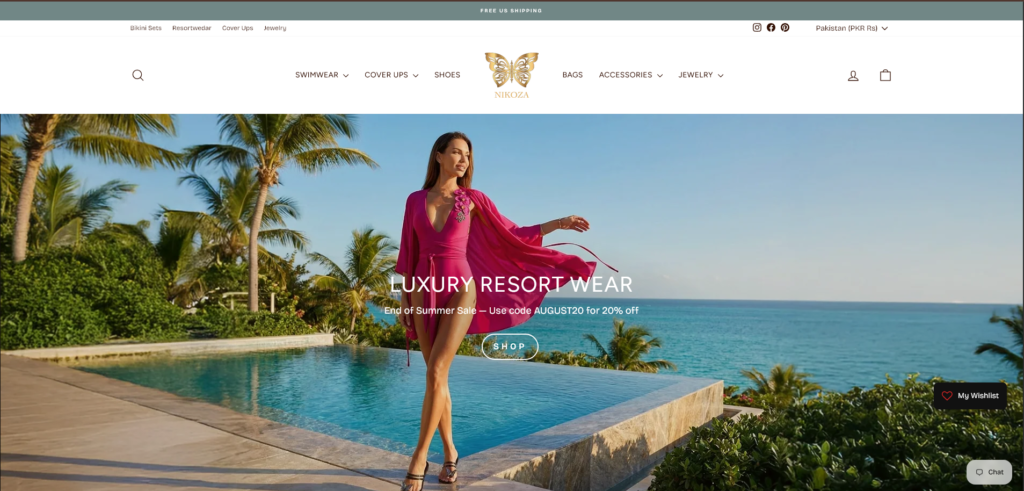
Through a focused ecommerce SEO strategy, I helped a luxury swimwear brand expand its organic search presence, improve commercial keyword rankings, and build a stronger connection between informational content, collection pages, and products.
The SEO campaign resulted in 183 ranking organic keywords, with several commercially valuable searches reaching the first page of Google.
Client Objective
The objective was not simply to increase website traffic.
For an ecommerce fashion brand, SEO traffic only becomes valuable when it brings potential customers closer to products they may actually purchase.
The SEO strategy therefore focused on increasing visibility for commercial and transactional searches related to designer swimwear, luxury swimwear, beachwear, bikinis, resortwear, beach bags, and fashion accessories.
The main objectives were to:
- Increase non-branded organic search visibility.
- Rank collection and product-related pages for buyer-intent keywords.
- Build topical authority around designer and luxury swimwear.
- Capture users at different stages of the buying journey.
- Improve visibility for long-tail product searches.
- Connect informational content with commercial collection and product pages.
- Prevent multiple pages from competing for the same keywords.
- Strengthen relevance between products, collections, supporting content, and search intent.
- Create sustainable organic visibility instead of depending entirely on paid advertising.
- Develop an SEO structure that could grow as new products and collections were added.
Rather than targeting random high-volume keywords, the campaign was designed around commercial relevance and the customer journey.
A visitor searching for inspiration needed to naturally move toward a collection, while somebody searching directly for a designer swimsuit or luxury swimwear needed to land on a page capable of converting that search into a sale.
Main Challenges
Luxury fashion ecommerce SEO presents a very different challenge from traditional service-business SEO.
The goal isn't simply to create articles and generate traffic. Every part of the SEO strategy has to support product discovery, brand positioning, purchase intent, and revenue.
Some of the main challenges included:
Highly Competitive Commercial Keywords
Terms around designer swimwear, luxury swimwear, bikinis, resortwear, and beachwear compete against established fashion retailers, marketplaces, magazines, and internationally recognised brands.
This meant the campaign needed to target both major commercial keywords and highly relevant long-tail opportunities.
Different Search Intent Across the Website
A single ecommerce website can have several different types of search intent:
- Informational
- Commercial investigation
- Category-based searches
- Product searches
- Style searches
- Trend-related searches
- Transactional searches
Each keyword needed to be mapped to the page type most likely to satisfy that search intent.
Traffic Alone Would Not Be Enough
Generic fashion content can generate visitors without generating customers.
The strategy therefore had to focus on topics capable of introducing products, collections, styles, or purchasing decisions naturally within the content.
Keyword Cannibalisation
Closely related terms such as:
- Designer swimwear
- Designer swimsuits
- Luxury designer swimwear
- Luxury designer bikinis
- Designer women's swimwear
- Designer beachwear
can easily cause several pages to compete against each other.
Clear keyword mapping was needed so Google could understand which page should rank for each search cluster.
Maintaining a Luxury Brand Identity
Luxury ecommerce content cannot feel like it was written purely for search engines.
Keyword optimisation had to be balanced with premium positioning, natural language, visual presentation, product storytelling, and the overall brand experience.
Connecting Content With Products
Blog traffic becomes far more useful when visitors have a clear path from:
Article → Collection → Product → Purchase
This required strategic internal linking and content planning rather than treating the blog as a separate section of the website.
Building Visibility Across a Wide Product Catalogue
The brand was relevant to multiple search themes including:
- Designer swimwear
- Luxury swimwear
- Bikinis
- One-piece swimsuits
- Beachwear
- Resortwear
- Beach bags
- Jewellery
- Butterfly jewellery
- Fashion accessories
The SEO strategy therefore needed to build relevance across multiple commercially connected topical clusters.
My Strategy
My Strategy
1. Ecommerce SEO Audit & Opportunity Analysis
I started by reviewing the website from both a search-engine and ecommerce perspective.
The objective was to understand:
- Existing organic visibility
- Ranking keywords
- Collection structure
- Product structure
- Content structure
- Indexable pages
- Internal linking
- Metadata
- Heading structure
- Search intent
- Keyword overlap
- Technical SEO opportunities
Rather than optimising individual pages without context, I first established how the entire website should work as an organic search ecosystem.
2. Commercial Keyword Research & Search Intent Mapping
The keyword strategy was built around how people actually search for fashion products.
Keywords were separated according to intent.
Core Commercial Keywords
Examples included:
- Designer swimwear
- Designer swimsuits
- Luxury swimwear
- Luxury designer swimwear
- Designer women's swimwear
- Designer bikinis
- Luxury designer bikinis
- Designer beachwear
Product & Style Searches
Additional opportunities included searches around:
- One-piece swimsuits
- Underwire swimwear
- Fuchsia swimwear
- Orchid swimwear
- Resort cover-ups
- Beach bags
- Designer pool bags
- Butterfly jewellery
Informational Opportunities
Informational keywords were selected when they could naturally introduce users to relevant products or collections.
Instead of chasing traffic for unrelated fashion questions, content topics were chosen based on their ability to move users further down the buying funnel.
3. Keyword-to-Page Mapping
Once the keyword research was completed, I mapped keyword clusters to the correct page types.
This helped establish a clear purpose for each page.
The structure followed a simple principle:
One primary search intent → One primary landing page
This reduced keyword cannibalisation and helped search engines understand the relationship between individual pages.
For example:
- Broad commercial keywords → Main collection pages
- Specific style searches → Relevant collections
- Individual product searches → Product pages
- Questions and inspiration searches → Blog content
- Supporting long-tail searches → Subcategories or relevant editorial content
Secondary semantic keywords were then incorporated naturally into each page.
4. Collection Page SEO Optimization
Collection pages were treated as some of the most commercially important SEO assets on the website.
Optimization focused on:
- Primary keyword targeting
- Secondary keyword variations
- SEO titles
- Meta descriptions
- H1 headings
- Supporting headings
- Introductory collection copy
- Semantic terminology
- Internal links
- Product relevance
- Search intent alignment
The goal was to make collection pages useful enough for search engines while maintaining the premium visual experience expected from a luxury fashion brand.
Instead of adding large blocks of generic SEO text, the content was designed to reinforce the collection's theme and purchasing intent.
5. Product Page Optimization
Individual product pages were optimized to capture more specific long-tail searches.
Product optimisation considered:
- Product names
- Product type
- Style
- Colour
- Material
- Design attributes
- Product descriptions
- Image alternative text
- Internal links
- Related collections
- Semantic product terminology
This helped expand the number of searches through which individual products could be discovered.
The keyword report later showed visibility across highly specific searches involving products, colours, styles, swimwear types, and jewellery.
6. TOFU → MOFU → BOFU Content Strategy
One of the most important parts of the strategy was creating content around the ecommerce buying journey.
I avoided building a blog filled with generic high-volume fashion topics.
Instead, content was structured around three stages.
Top of Funnel — Discovery
Topics designed to introduce potential customers to styles, trends, fashion ideas, and product categories.
Middle of Funnel — Consideration
Content helping customers compare:
- Styles
- Designs
- Swimwear types
- Trends
- Product features
- Different purchasing options
Bottom of Funnel — Purchase Intent
Commercially focused content targeting users already considering a purchase.
The goal was always to move users naturally from:
Search → Content → Collection → Product
This made the content strategy part of the ecommerce conversion journey rather than simply a traffic-generation exercise.
7. Internal Linking & Customer Journey Optimization
Internal links were used strategically to distribute both authority and users throughout the website.
Important pathways included:
Blog → Collection
Blog → Product
Product → Collection
Collection → Related Collection
Supporting Article → Commercial Landing Page
Anchor text was kept contextual rather than repeatedly forcing exact-match keywords.
This strengthened relationships between related pages while giving customers clear pathways toward relevant products.
8. Technical Ecommerce SEO
Technical SEO was reviewed to make sure search engines could efficiently crawl, understand, and index the pages that mattered.
Important areas included:
- Indexation
- Canonicalisation
- Duplicate URL control
- Crawlability
- Sitemap structure
- Robots directives
- Product URLs
- Collection URLs
- Pagination
- Internal redirects
- Broken links
- Page titles
- Heading hierarchy
- Image optimisation
- Mobile usability
- Page performance
Particular attention was given to avoiding unnecessary duplication commonly created on ecommerce websites through product variations, filtering, and multiple URL paths.
9. Semantic Relevance & Topical Authority
Instead of optimising pages around only one exact keyword, each important page was strengthened with related entities and semantic terminology.
For a luxury swimwear website, this meant building relationships between topics including:
- Designer swimwear
- Luxury swimwear
- Resortwear
- Beachwear
- Bikinis
- One-piece swimsuits
- Designer beach bags
- Swimwear styles
- Fashion accessories
- Jewellery
This gave search engines more context about the website's overall subject matter.
Over time, the site began appearing across a wider range of relevant searches rather than relying on only a handful of exact keywords.
10. Ranking Monitoring & Continuous Optimization
SEO performance was continuously reviewed to identify:
- Keywords approaching page one
- Keywords already ranking in positions 4–10
- Commercial terms needing additional support
- Pages showing new visibility
- Long-tail opportunities
- Internal linking opportunities
- Content gaps
- Pages requiring further optimisation
Pages ranking just outside the first page were particularly valuable opportunities.
Instead of constantly creating new pages, existing assets could be strengthened through better content, internal links, semantic coverage, and relevance.
This iterative process helped broaden organic search visibility across the website.
GSC Performance
Google Search Console performance screenshot added for this case study.
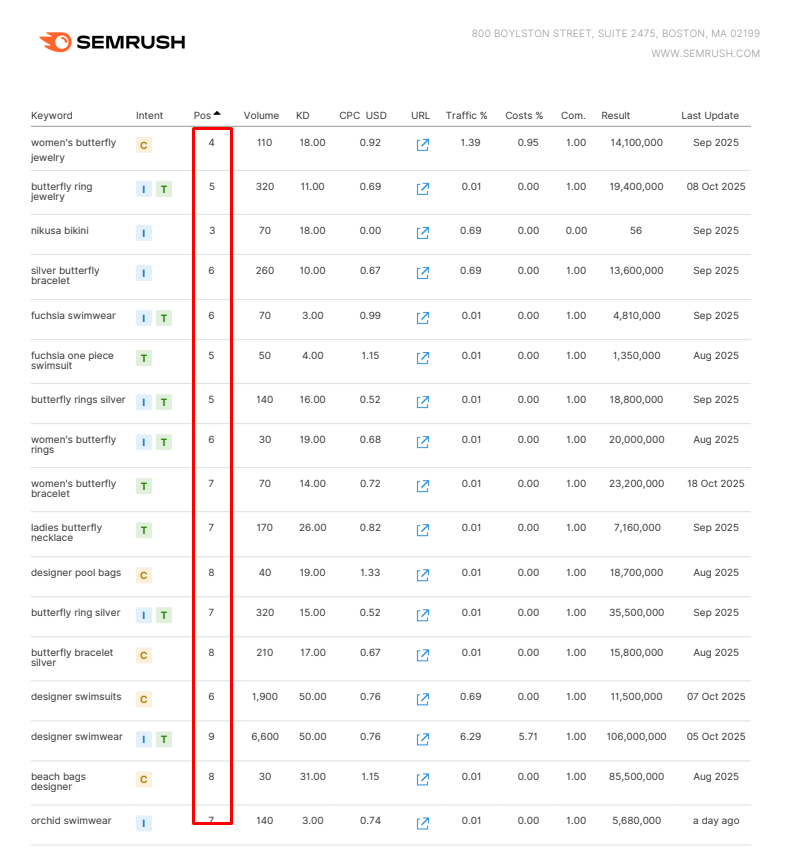
Rankings
Keyword-level movement recorded for this SEO campaign.
| Keyword | Starting Position | Current Position | Result |
|---|---|---|---|
| Ladies Designer Beachwear | Not in Top 100 | 2 | 98+ |
| Women's Butterfly Jewelry | Not in Top 100 | 3 | 97+ |
| Designer Swimsuits | Not in Top 100 | 3 | 97+ |
| Orchid Bathing Suits | Not in Top 100 | 3 | 97+ |
| Butterfly Jewelry | Not in Top 100 | 2 | 98+ |
| Designer Swimwear | Not in Top 100 | 4 | 94+ |
| Beach Designer Bags | Not in Top 100 | 6 | 94+ |
| Ladies Designer Beachwear | Not in Top 100 | 4 | 96+ |
| Luxury Designer Swimwear | Not in Top 100 | 4 | 96+ |
| Designer Women's Swimwear | Not in Top 100 | 6 | 94+ |
| Designer Luxury Swimwear | Not in Top 100 | 7 | 93+ |
| Luxury Designer Bikinis | Not in Top 100 | 3 | 97+ |
| Luxury Resort Swimwear | Not in Top 100 | 5 | 95+ |
Overall Results
Each result below is controlled from the editable Case Study fields in WordPress.