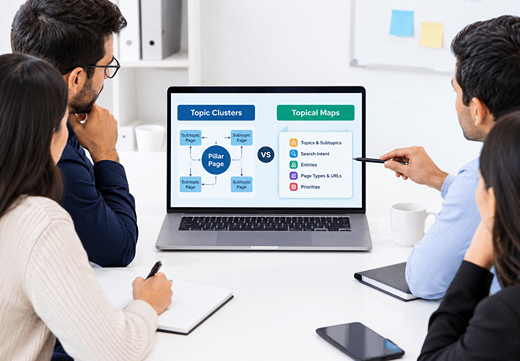
Topic Clusters vs Topical Maps is not an either-or decision. A topical map organizes subjects, subtopics, entities, search intent, and page relationships. A topic cluster is the connected group of pages that implements one part of that plan. The distinction matters because maps decide what deserves coverage; clusters organize pages around a pillar; internal linking creates information architecture; and both support semantic SEO and topical authority without guaranteeing rankings or AI Overview visibility.
What Are Topic Clusters in SEO?
Topic clusters organize published pages
A topic cluster or content cluster is a group of interconnected pages covering a main subject and its related subtopics. In topic clusters vs topical maps, a topic cluster includes a pillar page that provides an overview and supporting pages that answer specific questions, all connected through internal links to improve site structure and topical relevance.
An SEO website might use “SEO Content Strategy” as a pillar, with supporting pages about keyword mapping, search intent, content briefs, internal linking, and content refreshes. Each page has a distinct purpose, but the group works as one system.
Pillar pages and internal links
The pillar should address the broad subject and link to supporting resources. Cluster pages can link back to the pillar and related pages when useful. Descriptive anchor text gives users and Google context.
This structure is sometimes called content siloing, although useful relationships matter more than strict silos. Link across clusters when the relationship is genuine.
What Are Topical Maps in SEO?
Topical maps plan the content system
A topical map is a roadmap for a website’s content strategy. It organizes a core subject into topics and subtopics, then assigns relevance, intent, page types, URLs, and priorities. Ahrefs recommends considering brand relevance, business potential, and traffic potential instead of collecting every keyword.
A map may exist before pages are published. It can include URLs, primary and secondary keywords, entities, internal-link targets, content gaps, and actions such as create, improve, merge, redirect, or defer.
Keyword research, entities, and intent
A topical map uses keyword research as evidence, not the entire strategy. It records what people search for, why they search, what format they expect, and whether the topic fits the business. Search intent may be informational, commercial, transactional, or navigational.
It supports entity SEO by identifying associated people, products, organizations, concepts, and relationships. Consistent entity coverage can help search systems interpret content, including information associated with the Google Knowledge Graph. A map does not guarantee a Knowledge Graph entry or ranking.
Topic Clusters vs Topical Maps: The Key Differences
A topical map is strategic and comprehensive. It describes intended coverage, including topics without pages. A topic cluster is operational and page-based. It describes connected live or planned pages around one subject.
The map answers, “What should this site cover?” The cluster answers, “Which pages cover this subject, and how should they link?” A map can contain many clusters; a cluster is one implemented portion.
Their outputs differ. A map produces content architecture, URL priorities, and editorial direction. A cluster produces a pillar, supporting pages, links, and measurable performance. Treating them as synonyms can lead to pages without a plan or a plan without usable connections.
How Do Topic Clusters and Topical Maps Work Together?
Start with the map, then build the cluster
Begin with the business’s core subject and identify topics through audience questions, competitor research, Google Search, keyword tools, and content gap analysis. Keep relevant topics. Ahrefs and Semrush reveal competitor coverage, but judgment is needed to reject irrelevant opportunities.
Choose a priority cluster. Define its pillar, cluster content, intent, queries, page types, and business goal. See What Is a Topical Map in SEO? for an explanation of mapping topics and relationships.
Use information architecture and links
Turn the cluster into information architecture. Give each page a role, descriptive URL, and place in navigation or contextual linking. Connect the pillar to supporting content and link back when useful.
Google says crawlable links help it find pages and understand destinations. It recommends descriptive, concise anchor text rather than forced repetition.
When Should You Use Each Approach?
Use topical maps for planning decisions
Use a topical map when launching a site, entering a niche, restructuring content, auditing coverage, or deciding whether a subject deserves its own page. It is useful when keywords overlap and a team needs one source of truth.
If unsure whether a topic needs a URL, read How to Decide Whether an SEO Topic Needs Its Own Page. Search intent should guide the decision more than keyword similarity.
Use clusters for execution and improvement
Use topic clusters when publishing a pillar and supporting resources, improving internal linking, strengthening topical authority, or measuring performance by subject. Check whether pages answer distinct intents or compete. Consolidate overlapping pages instead of expanding a weak cluster.
Avoid creating thin pages for every keyword or publishing a pillar without useful support and links. Google favors helpful, reliable, people-first content over pages made mainly to attract search traffic.
How Do You Measure and Maintain the System?
Measure maps by coverage quality and decision progress. Track important topics with useful pages, remaining gaps, distinct URL purposes, and planned internal relationships. A completed map is not successful if topics are irrelevant or pages are thin.
Measure clusters by impressions, clicks, rankings, organic traffic, conversions, and internal-link engagement. Google Search Console reveals queries and pages receiving visibility. Review clusters when audiences, products, competitors, or results change.
An SEO content strategy connects these activities to business priorities. For implementation, see SEO Content Strategy from an On-Page SEO Consultant. Use What Is an SEO Content Brief and What Should It Include? to create assignments.
Use both: the topical map provides direction, while topic clusters create connected, navigable content.

Areesh Ishtiaq
Freelance SEO Professional helping businesses improve visibility across Google Search, Google Maps and AI-powered search.
Explore Areesh IshtiaqFrequently Asked Questions
No. A topical map is the planning framework. A topic cluster is connected pages implementing one subject within it.
A topic cluster connects a pillar with supporting pages so users can move from broad explanations to detailed answers.
It should contain topics, subtopics, intent, entities, page types, URLs, content gaps, priorities, and internal-link relationships.
No. They support coverage and relationships, but rankings also depend on quality, relevance, accessibility, competition, and Google’s systems.
No. Combine related keywords when intent is shared. Create a page when the topic has a distinct need, format, audience, or business purpose.