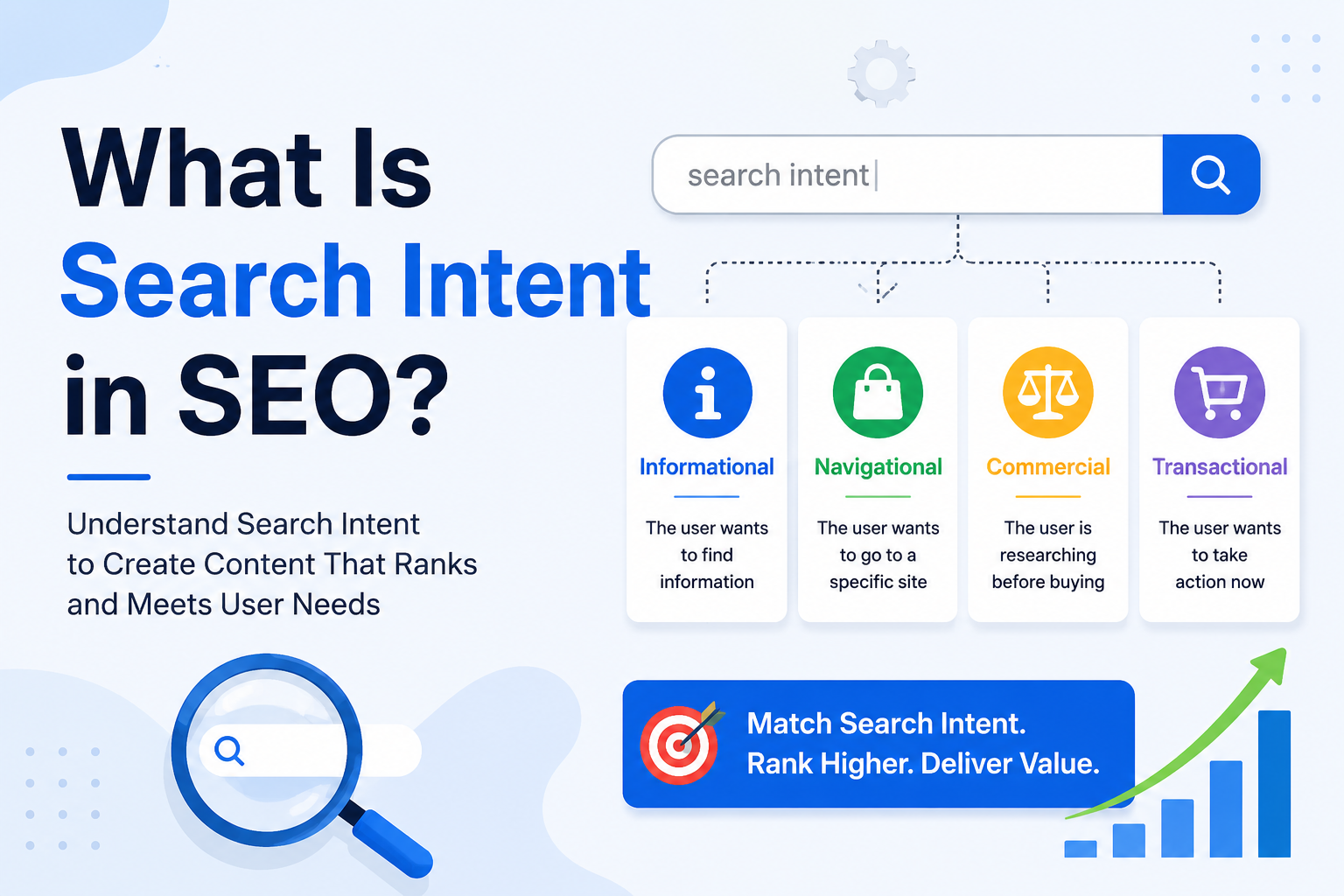
If you are asking “What Is Search Intent in SEO?”, the answer is the purpose behind a Search Query:
- Informational intent means the user wants to learn;
- Navigational intent means the user wants a destination;
- Commercial intent means the user is comparing options; and
- Transactional intent means the user is ready to act or buy.
Search intent matters because Search Engines match results to Query Meaning, User Needs, and Search Context—not repeated Keywords.
What Does Search Intent Mean in SEO?
Search Intent, also called User Intent, Keyword Intent, or Searcher Intent, is the goal behind a search. It helps an SEO professional choose the right Content Type, Format, and page structure. “How to improve page speed” seeks instructions, “best page-speed tool” suggests comparison, and “PageSpeed Insights” may be navigational. Similar words can express different Search Purpose.
Search intent versus keywords
Keywords describe the language people use; search intent explains the goal behind it. Keyword Research reveals Search Volume, Keyword Difficulty, Long-Tail Keywords, and Search Trends, but not every User Need. Combine keyword data with intent analysis to select a Blog Post, Buying Guide, Product Page, Landing Page, or support document. This improves Content Relevance.
What Are the Main Types of Search Intent?
SEO commonly uses four intent categories: informational, navigational, commercial, and transactional. These are useful frameworks; intent can change during the Customer Journey.
Informational and navigational intent
Informational Intent means the searcher wants an answer, definition, tutorial, or solution, such as “what is semantic search.” Blog Posts, guides, videos, and FAQs should answer quickly.
Navigational Intent means reaching a known brand, website, tool, login page, or resource, such as “Google Search Console.” The best result is an authoritative destination page supported by clear branding, descriptive titles, crawlable pages, and strong Site Structure.
Commercial and transactional intent
Commercial Intent occurs when users compare solutions or providers, for example “SEO platform comparison.” Buying Guides, reviews, and comparisons support evaluation.
Transactional Intent indicates readiness to act, such as “hire freelance on-page SEO consultant” or “book a technical SEO audit.” Product Pages, service Landing Pages, and forms should make the next step clear.
How Does Search Intent Affect SEO?
Search intent affects whether a page is relevant and whether its format meets the query’s expectation. An educational article may not satisfy a SERP dominated by Product Pages, while a sales page may disappoint someone seeking a neutral explanation. Matching intent supports qualified Organic Rankings and conversions.
Google uses many relevance and quality signals and emphasizes helping Search Engines understand content and users decide whether to visit. Intent alignment supports, but does not replace, Technical SEO, Content Quality, or authority.
Intent improves relevance and conversions
When a page answers the right question in the expected format, visitors are more likely to read, explore, or convert. Intent prioritizes SEO work: informational queries may build awareness, while transactional Long-Tail Keywords may produce better leads. Evaluate traffic by relevance and Conversion, not Search Volume alone.
Intent changes across the customer journey
Intent changes across the Customer Journey. An educational Blog Post can link to a Buying Guide, then to a Product Page or service Landing Page. This creates a logical path from discovery to action.
How Do You Analyze Search Intent in SEO Strategies?
Begin with the target Search Query and study what Google considers relevant. Review the first-page SERPs for dominant Content Format, page types, titles, subtopics, SERP features, and competitor depth.
Use SERP analysis and keyword research
SERP Analysis reveals what users and Google appear to expect. Featured Snippets and People Also Ask often indicate informational intent; maps, brand pages, Product Pages, and shopping results suggest local, navigational, commercial, or transactional intent. AI Overviews add context but are not a ranking formula.
Combine SERPs with Keyword Research. Study modifiers such as “what,” “best,” “vs,” “price,” “near me,” “buy,” “hire,” and “login.” Use Search Trends, but do not assume the highest-volume phrase is the best target.
Map intent to the right content
Create a brief recording the query, intent, audience, outcome, Keywords, entities, internal links, and conversion goal. Choose the matching Content Type: explanations for informational queries, evaluation for commercial queries, proof and action for transactional queries, and a clear destination for navigational queries.
How Can You Identify Transactional Search Intent?
Transactional intent often appears through action-oriented modifiers such as “buy,” “order,” “book,” “hire,” “subscribe,” “quote,” “pricing,” and “near me.” These signal readiness for a provider, product, or immediate solution.
Match transactional queries to conversion pages
If SERPs favor Product Pages, service pages, local listings, or pricing pages, create a focused Landing Page with a clear value proposition, proof, transparent details, calls to action, and answers to objections about cost and suitability.
Do not send a transactional visitor to a generic Blog Post, or turn an informational page into an aggressive sales pitch. Match the page to the searcher’s Customer Journey.
What Is Navigational Search Intent in SEO?
Navigational intent means reaching a specific brand, product, domain, platform, or feature. A strong result uses a descriptive title, recognizable branding, accurate URL, and clear navigation. Dedicated destination pages, Internal Links, and logical Website Structure help users and crawlers find them. Read why your website is not showing up on Google.