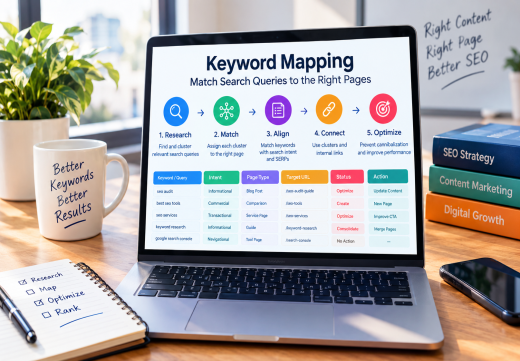
Keyword Mapping groups related search queries and assigns each group to the page that best satisfies its Search Intent. It gives queries a target URL, turns Keyword Research into Content Strategy, reveals content gaps, and reduces Keyword Cannibalization. A useful map records intent, page type, URL, status, and next action—not just keywords.
What Is Keyword Mapping?
Keyword mapping connects queries to pages
Keyword mapping, or Content Mapping for search, assigns a primary keyword or topic cluster to an existing or planned page. It can also record secondary keywords, intent, content type, rankings, and action.
The objective is alignment. A definition query belongs on an educational page, while product or service results may require a commercial landing page.
Why keyword mapping matters for SEO
Without a map, a site may publish overlapping pages while leaving valuable queries unanswered. This creates inconsistent On-Page SEO and unclear priorities.
A map supports Content Strategy by showing which page owns a topic, which terms are supporting language, and how URLs should connect.
Build a Keyword Mapping Strategy From Research Data
Collect and cluster relevant search queries
Begin with topic areas that match your audience, products, services, and expertise. Expand them through Google Keyword Planner, Search Console, competitor research, Ahrefs, SEMrush, and Moz. Record volume, difficulty, relevance, and intent.
Group queries that express the same need. Similar wording does not automatically require separate pages. If queries produce similar results, one URL can often cover them. Shared SERP patterns are more reliable than matching words alone.
Assign each cluster to an existing or new page
Audit current URLs first. If an existing page matches the cluster’s intent, map it to that URL for optimization. If no suitable page exists, mark the opportunity for creation.
A practical map can include topic cluster, primary keyword, secondary keywords, intent, target URL, page type, status, priority, and review date. Keep one primary purpose per page.
Match Keywords to Search Intent and SERPs With Keyword Mapping
Use SERP analysis to choose the right page type
Study the primary query before assigning a URL. Note whether Google favors guides, category pages, products, services, comparisons, tools, or local results. Then identify the dominant angle, such as “beginner,” “best,” “pricing,” or “step-by-step.”
This SERP Analysis reveals what Google currently interprets as relevant. “Keyword research” may favor educational guides, while “keyword research services” may favor consultant landing pages. A well-written page is still a poor target if its format mismatches the SERP.
For intent categories, read The Main Types of Search Intent. Treat informational, navigational, commercial, and transactional intent as flexible classifications. Mixed intent may justify one comprehensive page.
Organize Pages With Clusters and Internal Links
Connect pillar pages to supporting content
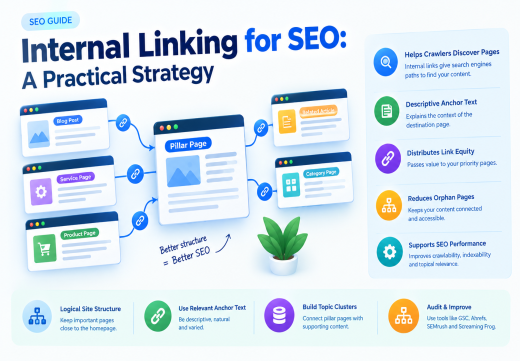
Topic Clusters give related pages a deliberate relationship. A broad Pillar Page covers the subject, while supporting pages answer narrower questions. Link them when the relationship helps users.
This supports Information Architecture by showing page hierarchy and priority. Use a stable, descriptive URL Structure that reflects purpose without forcing every keyword into the slug.
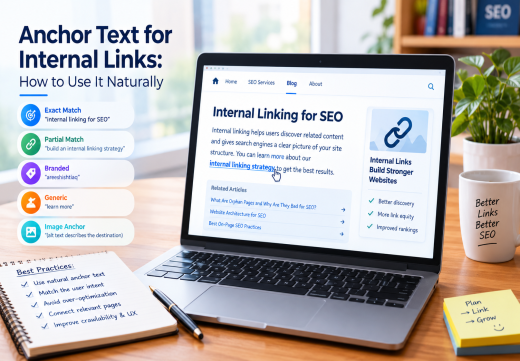
Internal Linking should reinforce the map. Link relevant, established pages to important targets with descriptive anchor text. Google says links aid discovery and relevance, and important pages should have an incoming site link. See Anchor Text for Internal Links.
Prevent Keyword Cannibalization
Find and fix competing page targets
Keyword Cannibalization occurs when multiple pages target the same or closely related query with overlapping intent. Mentioning a keyword on several pages is not automatically a problem; conflict arises when no clear primary page exists.
Start with Google Search Console. Filter the Performance report by query and inspect which URLs receive impressions, clicks, and positions. Compare their purpose and format. Ahrefs, SEMrush, and Moz can add ranking and overlap reports.
Do not merge automatically. If intents differ, clarify roles and strengthen internal links. If pages duplicate one purpose, consolidate the strongest information, redirect when appropriate, and update links. Yoast SEO and Rank Math can support implementation, but the decision requires content and SERP analysis.
Use and Maintain the Keyword Map
Mark every topic with a clear action.
A map becomes useful when it leads to decisions. Mark each topic Create, Optimize, Consolidate, Redirect, or No Action. Prioritize business value, intent, quality, performance, difficulty, and URL strength.
When optimizing, use the primary keyword naturally in the title, H1, introduction, and relevant sections. Use secondary keywords as useful subtopics; do not force every mapped term into the copy.
For keyword clustering, query interpretation, and page recommendations, consider On-Page SEO Consultant support through the supplied keyword-research resource.
Review Rankings, Pages, and Content Gaps With Keyword Mapping
Keyword Mapping is not a one-time document. Revisit it after major launches, migrations, consolidations, product changes, and SERP shifts. A quarterly review is a reasonable starting point.
Use Google Search Console for query and page performance. Use Ahrefs, SEMrush, or Moz for opportunities, overlap, and competitors. Use Yoast SEO or Rank Math for implementation checks, then update URLs, statuses, priorities, and dates.
A strong map answers five questions: What does the query mean? Which page satisfies it? What is that page’s purpose? Which pages support it? What happens next? Clear answers make SEO easier to execute and measure.

Areesh Ishtiaq
Freelance SEO Professional helping businesses improve visibility across Google Search, Google Maps and AI-powered search.
Explore Areesh IshtiaqFrequently Asked Questions
Keyword mapping assigns search queries or topic clusters to the existing or planned pages that best satisfy their search intent.
One page can target a primary keyword and several closely related secondary terms when they share the same intent and can be covered naturally.
It helps prevent cannibalization by giving each page a distinct topic, intent, and primary target. Existing overlap still requires performance and SERP analysis.
No. Group queries with the same intent when one page can satisfy them. Create a separate page when the query requires a different purpose, format, or audience.
Review it at least quarterly and sooner after major publishing, pruning, migrations, algorithm changes, or meaningful shifts in search results.