Anchor Text for Internal Links is the clickable wording that connects one page on your website to another. Use it naturally by describing the destination accurately; matching the words to the sentence and searcher intent; varying exact, partial, branded, generic, and related wording instead of repeating one keyword; and placing links where they help users navigate your Site Architecture. Natural anchors support SEO, crawlability, and user experience because they give people and Google useful context without forcing keywords into the copy.
What Is Anchor Text for Internal Links?
How Anchor Text for Internal Links Describes the Linked Destination
Anchor text is the visible, clickable text in a hyperlink.
In <a href="/technical-seo/">technical SEO services</a>, “technical SEO services” tells readers and search engines about the destination.
An internal link points to another URL on the same domain. It differs from a backlink, which comes from another website. Both use anchor text, but internal links are under your control. That makes them a practical part of on-page Search Engine Optimization, navigation, content organization, and link building.
Why Anchor Text for Internal Links Affects SEO
Google uses links to find pages and understand relationships. It generally processes crawlable HTML links with a valid href and recommends concise, descriptive anchor text.
Clear link text helps users decide whether to click. “Technical SEO audit” sets a better expectation than “click here,” improving accessibility and User Experience. Anchor text is a context signal, not a ranking guarantee.
Understand the Main Types of Anchor Text
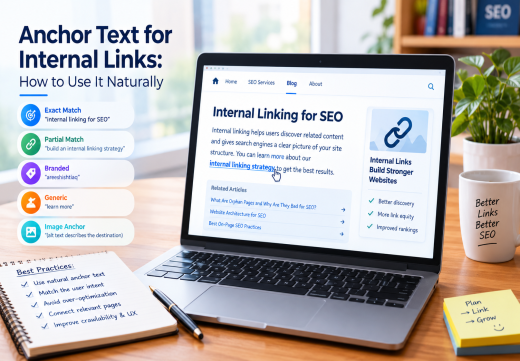
Exact match and partial match anchors
An exact match anchor uses the target page’s primary keyword exactly, such as “internal linking for SEO.” It can be appropriate when accurate, but repeating it everywhere can feel mechanical and cause competing page signals.
A partial match anchor includes the target concept with altered wording, such as “build an internal linking strategy.” It often fits naturally and provides broader context. Use keyword optimization for clarity, not forced repetition.
Branded, generic, and image anchors
A branded anchor uses a company or product name. A generic anchor uses “read more,” “this guide,” or “learn more.” Generic wording can work when surrounding text explains the destination, but should not be the default on important links.
An image anchor uses an image link. Google may use its alt text as the link’s text, so describe the destination accurately. A naked URL or page-title anchor can also be valid, although descriptive phrasing is usually clearer in editorial content.
Choose Natural Anchor Text for Internal Links in Context
Match the anchor to the sentence and page
Read the sentence without the URL. Would a reader understand why the link is there and what the destination contains? If the anchor sounds inserted only to repeat a keyword, revise or remove the link.
“Review these orphan-page fixes before your audit” is natural. “For more information, click here” gives less context. The best anchor is concise, relevant, and honest. Google also advises considering surrounding words.
Use variations that reflect real language, such as “on-page SEO services” or “page-level SEO support,” when they accurately describe the destination.
Avoid over-optimization and competing links.
Do not create a fixed anchor-text ratio. Use an exact match when it is clearest, then use partial, related, branded, or page-title anchors where they fit better.
Identical keyword-heavy anchors can make copy unnatural and blur the primary resource. Yoast highlights this competing-links problem when multiple pages target the same phrase. Prioritize one authoritative page and distinguish supporting pages.
How Anchor Text for Internal Links Connects to Site Architecture
Link priority pages from relevant hubs
Anchor text works best inside a logical Site Architecture. Use contextual links between pillar pages and focused resources, such as service pages to relevant guides or older articles to newer resources.
This supports link equity, sometimes called “link juice,” by creating paths for internal authority. PageRank is Google’s link-analysis system; every link does not provide equal value. A relevant link is more useful than unrelated footer links.
For a broader linking framework, read Internal Linking for SEO: A Practical Strategy.
Support Crawlability and User Experience
Use visible, crawlable links with purpose
Important pages should be reachable through standard internal links, not only through a search box, hover interaction, or unreliable script. Keep links visible, mobile-friendly, and connected to real URLs. Avoid link blocks that obscure priorities.
Do not use nofollow on normal editorial links without a clear reason. Reserve it for utility or access-controlled destinations rather than PageRank sculpting.
Internal anchors can prevent Orphan Pages by giving new content an entry path. Link valuable pages from established content; consolidate, redirect, delete, or noindex pages that should not be in search. See What Are Orphan Pages and Why Are They Bad for SEO?.
Audit Anchor Text and Improve It Over Time
Use SEO tools to find weak anchors
Start with Google Search Console to identify pages with few incoming links. Screaming Frog can reveal “click here” anchors, crawl depth, and opportunities. Ahrefs Site Audit and SEMrush can report orphan pages, broken links, and weak connections. Moz Pro analyzes crawl depth, while Yoast SEO suggests related WordPress links.
Prioritize pages with valuable content, backlinks, impressions, conversions, or business importance. Replace broken destinations, rewrite misleading anchors, and remove distracting links. These are core SEO best practices. Confirm that each target is indexable and canonical.
For page relevance, headings, content structure, and internal-link decisions, consider On-Page SEO Services from an On-Page SEO Consultant.

Areesh Ishtiaq
Freelance SEO Professional helping businesses improve visibility across Google Search, Google Maps and AI-powered search.
Explore Areesh IshtiaqFrequently Asked Questions
Use concise wording that accurately describes the page and fits the surrounding sentence.
No. Partial, related, branded, and page-title anchors can provide better readability and context.
Click here” provides little context, so use generic anchors sparingly.
There is no fixed limit. Repeat it when clearest, but vary wording when repetition becomes unnatural.
Usually not for useful editorial links. Keep them followed unless a utility or access reason calls for nofollow.