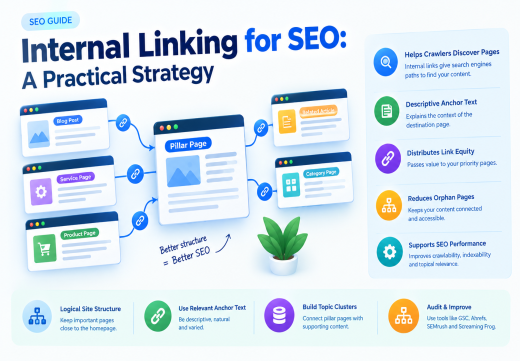
Internal Linking for SEO connects pages on the same website with relevant, crawlable links. It works because links help Google and Bing discover pages; descriptive Anchor Text explains destination context; links distribute Link Juice, or link equity, toward priority pages; and structure reduces Orphan Pages and supports Search Engine Optimization. The goal is useful paths, not maximum link volume.
What Is Internal Linking for SEO?
Internal links connect content on one domain
An internal link points from one URL to another on the same website. It can appear in navigation, categories, breadcrumbs, related content, or an article. Unlike Backlinks, internal links are controlled by the site owner, making them central to page discovery and Site Architecture.
Google generally crawls links represented by an HTML <a> element with a resolvable href. A link hidden behind an unsupported interaction or an empty destination may not provide the same discoverability as a standard HTML link.
Why internal links matter to SEO
Internal links help users move through related information and help search engines understand page relationships. PageRank is Google’s link-analysis system, while “Link Juice” is an informal term for ranking value described as flowing through links. Neither means that a random link guarantees a ranking increase.
The strongest benefit comes from relevance and structure. A guide linked to a related service page clarifies both pages; linking everything to everything creates noise.
Plan a Site Architecture That Reflects Page Priorities
Identify pages that deserve the strongest support
Start with a URL inventory and classify pages by business value, search demand, and user purpose. Priority pages include services, product categories, cornerstone guides, and conversion pages. Ensure each important page is reachable from another relevant page. Google recommends keeping valuable pages within several clicks of the homepage, but this is not a universal ranking rule.
Review your Sitemap as a source of known URLs, not a replacement for internal navigation. It can help discovery but does not create topical relationships or guarantee indexing. A sitemap-only page may be valuable, forgotten, or intentionally isolated.
Build hubs, pillars, and topic clusters
A useful structure connects a broad pillar page with narrower cluster pages. The pillar introduces the topic; supporting pages answer focused questions. Link between them when the relationship helps readers.
For example, a technical SEO hub might connect to pages about crawling, canonicalization, XML sitemaps, and orphan pages. This gives important pages more relevant entry points than a blog archive alone.
For a wider structural framework, read Website Architecture for SEO.
Choose Anchor Text and Link Placement Carefully
Write Descriptive, Natural Anchor Text for Internal Linking for SEO
Anchor Text is the clickable wording of a link. Use concise text that tells users what they will find. “Technical SEO audit” is more informative than “click here,” while “learn more” is useful only when the surrounding sentence supplies clear context.
Use natural variations rather than repeating one exact-match phrase. Google advises against cramming keywords into anchor text. The anchor should accurately describe the destination and fit its surrounding sentence.
Prioritize contextual and navigational links. Contextual links connect a concept to a useful next step. Navigation, breadcrumbs, category links, and related-content sections provide additional paths. Use each for its real purpose rather than inserting sitewide links to manipulate authority.
Place important links where users can notice and use them. Confirm mobile visibility, valid URLs, and crawlable implementation. There is no universal ideal count; a few relevant links are better than a crowded page.
Support Crawlability, PageRank, and Crawl Budget
Keep important pages discoverable
Internal links are a primary route for a Crawler to find new or updated pages. Link new content from an established, relevant page rather than relying only on a sitemap or external backlink.
Crawl Budget mainly concerns very large or frequently updated sites. Google describes it through crawl capacity and demand. Duplicate URLs, faceted navigation, soft 404s, long redirects, and unnecessary pages can consume crawl resources. Internal Linking for SEO helps guide crawlers toward useful, indexable content while supporting a clear site structure and efficient crawling.
If you need a definition and remediation workflow for Orphan Pages, read What Are Orphan Pages and Why Are They Bad for SEO?. Fix valuable orphans with relevant links; redirect, noindex, consolidate, or delete pages that should not remain part of the search index.
Audit Internal Links With SEO Tools
Combine crawl, link, and performance data
A useful audit checks more than link count. Use Google Search Console to review the Links report and pages with few internal links. Screaming Frog can identify broken destinations, crawl depth, and orphan URLs when combined with sitemap or analytics data.
Ahrefs and SEMrush can surface link opportunities, orphan pages, broken links, and pages with one incoming link. Moz Pro analyzes crawl depth, while Yoast SEO can suggest related WordPress links. Manual review confirms relevance.
Prioritize pages with backlinks, impressions, conversions, or strong content but weak internal support. Replace broken links, remove irrelevant links, and monitor changes instead of treating every warning as urgent.
Apply a Repeatable Internal Linking Workflow
Link new and existing content together
Before publishing, identify the target topic, parent hub, related pages, and next action. Add an incoming link from an established page and link to relevant resources. Then update older pages that naturally mention the subject.
Review links after migrations, redesigns, URL changes, pruning, and template updates. Check broken links, redirects, accidental nofollow, non-canonical destinations, and crawl blocks. Keep sitemap, canonical, navigation, and link signals consistent.
A practical review is: export important URLs, crawl the site, compare links with Search Console and sitemap data, prioritize pages, implement changes, and measure impressions, clicks, rankings, and conversions. For page-level relevance, consider On-Page SEO Services from an On-Page SEO Consultant.

Areesh Ishtiaq
Freelance SEO Professional helping businesses improve visibility across Google Search, Google Maps and AI-powered search.
Explore Areesh IshtiaqFrequently Asked Questions
There is no fixed number. Add links that help users and clarify relationships; remove repetitive or irrelevant links.
They can support discovery, relevance, architecture, and internal link equity. They do not guarantee rankings.
Use concise, descriptive wording that accurately explains the destination. Vary phrasing naturally.
Yes, if the page is valuable. Link it from an established page or navigation. Do not link pages that should be redirected, noindexed, or deleted.
Useful editorial links should remain followed. Use nofollow only for appropriate utility or access-controlled destinations.