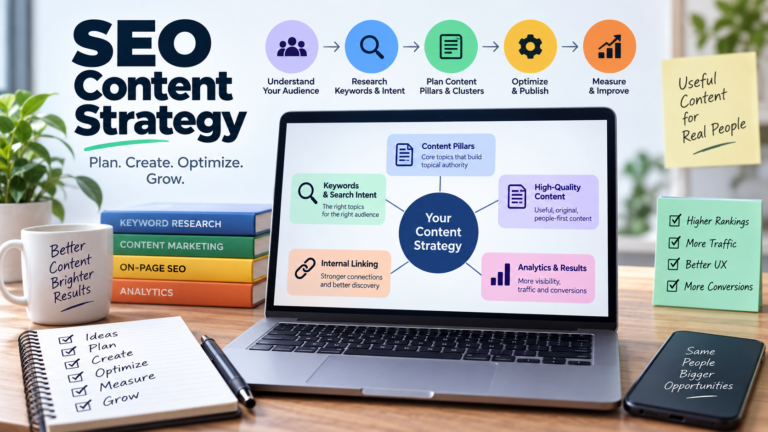
An SEO Content Strategy is a planned system for creating, optimizing, organizing, and measuring content so it serves people and earns relevant visibility in search. It connects business goals with audience needs uses keyword research and search intent to choose topics organizes pages into topic clusters with pillar pages and internal links and measures rankings, organic traffic, engagement, and conversions. It combines content marketing with search engine optimization, but it is not a plan to publish as much content as possible.
What Is an SEO Content Strategy?
Define the strategy’s purpose
An SEO content strategy explains why a business publishes content, whom it serves, what topics it should own, and how each page supports an outcome. It may increase organic traffic, educate buyers, generate leads, or support sales.
The strategy should prioritize people over search-engine manipulation. Google recommends helpful, reliable, original, accurate content created for an audience. A page should satisfy a visitor’s need rather than force keywords into every paragraph.
Connect content marketing with SEO
Content marketing attracts and helps an audience through articles, landing pages, guides, comparisons, videos, and other formats. SEO makes content easier to discover and understand. Search data informs demand, while audience knowledge determines what deserves publication.
A strong strategy considers the full journey. Informational content creates awareness, commercial content supports evaluation, and service pages support action. Conversion rate optimization improves the next step.
Build the Strategy Around Audience and Search Demand
Use keyword research and search intent
Begin with keyword research, but do not select topics from search volume alone. Group queries by meaning, audience need, difficulty, business relevance, and search intent. Identify whether people want an explanation, comparison, solution, product, service, or specific website.
Study the current SERP to see page types, formats, angles, and questions. This SERP analysis prevents a mismatch between query and page. A product page may not satisfy a “how does it work” query, while a blog post may not satisfy a buyer.
Map topics to business goals
Create a content map connecting each topic to an audience stage, target query, page type, conversion, and internal destination. Avoid several pages for the same purpose. A content audit can reveal pages to refresh, consolidate, redirect, or retire before new content is commissioned.
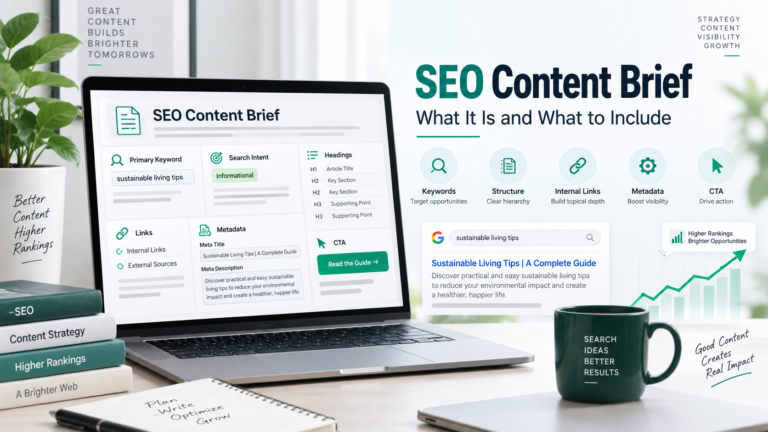
Use a content brief to guide each priority. Include the audience, search intent, primary and secondary terms, questions, page angle, headings, evidence, internal links, and call to action. A brief improves consistency without turning writing into a formula.
Organize Topics with Pillar Pages and Clusters
Create pillar pages for core subjects
A pillar page is a substantial resource covering a broad topic that matters to the business and audience. It provides an overview and links to focused supporting pages. Choose a topic broad enough to generate subtopics but specific enough to serve an audience.
An SEO consultancy might build a pillar page about on-page SEO, supported by pages about title tags, headings, internal links, and intent. The pillar should help users reach the next resource.
Build topic clusters and internal links
A topic cluster connects a pillar page with related content. Link between pages with descriptive anchor text and a logical path. This helps people explore the subject and helps Google understand relationships among pages. It can also distribute link equity across important URLs.
Review existing pages first. Backlinks can strengthen URLs, while overlapping intent can create cannibalization. Aim for coherent information architecture, not a fixed article count.
Plan and Produce Useful Content
Use a content calendar and content brief
A content calendar turns priorities into a schedule. Record the topic, query, owner, format, funnel stage, deadline, update date, internal-link targets, and success metric. Balance evergreen resources with timely content that matters to the audience.
Use the brief to define the main question, opening answer, subtopics, sources, voice, and conversion path. Planning reduces thin pages and keeps production aligned.
Treat AI content as an editorial aid, not an automatic publishing system. AI can help with outlines or checks, but people must verify facts, add insight, apply expertise, and protect trust. Trust also relates to E-E-A-T: experience, expertise, authoritativeness, and trustworthiness. Google focuses on usefulness and purpose, not automation.
Optimize Content for Search and Experience
Improve each page’s on-page SEO without reducing readability. Make the title, headings, URL, meta description, images, and structured data consistent with its purpose. Use related concepts naturally. See Title Tag Optimization.
Prioritize user experience. Make answers easy to scan, cite trustworthy sources, improve mobile presentation, and remove intrusive elements. A page that attracts a click but fails to help will not perform. See On-Page SEO Services from an On-Page SEO Consultant.
Refresh content strategically
Refresh pages when information, intent, competitors, or performance changes. A content audit can reveal content decay, weak evidence, poor structure, missing internal linking, or the need for a different format. See How to Refresh Existing Content for a practical process.
Measure and Improve the Strategy
Use Google Search Console to monitor queries, impressions, clicks, position, and search appearance. Use Google Analytics to understand sessions, engagement, leads, purchases, and other actions. The tools measure different stages, so totals will not match exactly.
Ahrefs and Semrush support research, competitor analysis, backlinks, rankings, and gaps. Surfer SEO and Clearscope compare topical coverage, headings, questions, and readability during content optimization. Connect tool recommendations with real audience and business outcomes.
Review performance by page and cluster, not total traffic. A page may rank for more queries but attract less qualified visitors. Track conversions, assisted conversions, engagement, and sales alongside rankings. Update the strategy when audience needs, SERPs, or priorities change.

Areesh Ishtiaq
Freelance SEO Professional helping businesses improve visibility across Google Search, Google Maps and AI-powered search.
Explore Areesh IshtiaqFrequently Asked Questions
It is a plan for researching, creating, organizing, optimizing, and measuring content that serves people and supports organic search visibility and business goals.
It prevents random publishing by connecting topics to audience needs, search intent, site structure, conversions, and measurable performance.
Define business and audience goals, research queries, analyze intent and competitors, map topics to pages, build clusters, publish useful content, and measure results.
Topic clusters are related pages organized around a broad pillar page. Internal links connect the pillar and supporting pages so users and search engines understand their relationship.
Google Search Console and Google Analytics measure performance. Ahrefs and Semrush support research, while Surfer SEO and Clearscope assist content optimization.