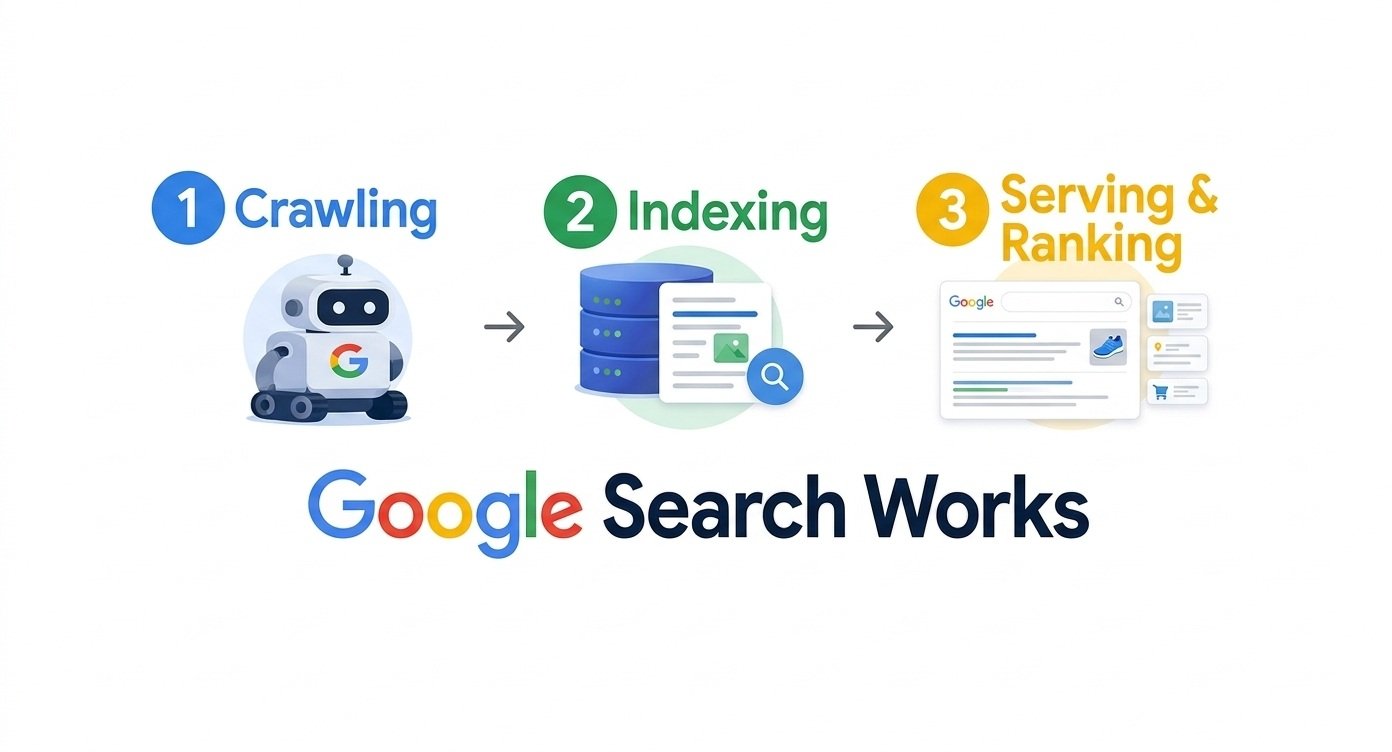
How Google Search Works has three main stages: crawling, when Googlebot discovers and fetches pages; indexing, when Google analyzes and stores page information in the Google Index; and serving and ranking, when search algorithms match a query with relevant results. A page may not appear because Google has not discovered it, could not crawl it, selected another canonical page, or decided it was not valuable or relevant enough to index. An indexed page is eligible to appear, but it is not guaranteed to rank.
How Does Google Search Work?
Google Search is an automated system that processes web pages and returns results for a user’s query. Google’s official model separates Search into crawling, indexing, and serving results. This sequence helps diagnose technical, content, or ranking problems.
The Three Stages of How Google Search Works
During crawling, a web crawler discovers URLs and downloads page resources. During indexing, Google analyzes text, images, video, metadata, language, usability, and duplicate relationships. The processed information is then stored in the Google Index. Understanding How Google Search Works helps explain how these stages connect: when someone searches, Google retrieves relevant pages from its index and orders them using many signals to deliver the most useful results.
The Google Index can be understood conceptually as an inverted index: terms and concepts point to documents, enabling fast retrieval.
What happens when a user searches?
Google interprets the query, considers meaning and context, searches its index, and generates a SERP with organic results and possible features such as images, local listings, featured snippets, or rich results. Results vary by language, location, device, and freshness.
Google Ads are paid placements and separate from organic ranking. Google Analytics measures activity after users arrive; it does not submit pages to Google. Google Discover is a personalized feed that can show content without a traditional query, so Discover visibility differs from SERP rankings.
How Does Googlebot Discover and Crawl Pages?
Crawling is Google’s process for finding and fetching pages. Googlebot is Google’s web crawler. Its systems decide which sites to crawl and when, without overloading servers.
How Googlebot finds new URLs
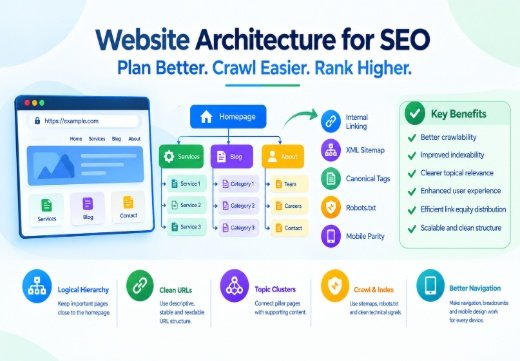
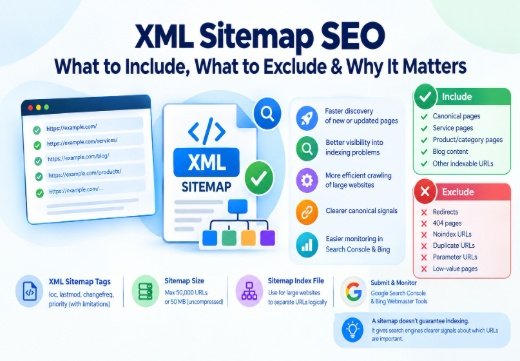
Googlebot discovers URLs through links from known pages, external references, redirects, and XML sitemaps. A logical site structure and relevant internal links help Google find important pages. A sitemap communicates preferred URLs, but submitting one does not guarantee crawling or indexing.
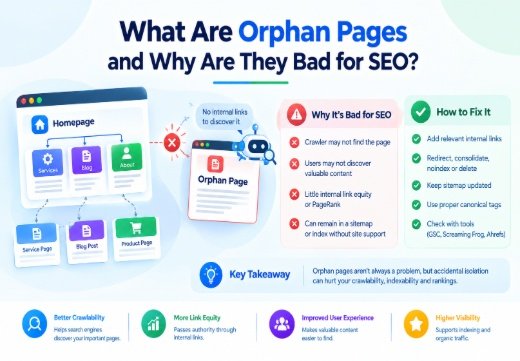
A new page with no links may remain undiscovered. Link important pages from navigation, categories, or relevant articles.
How crawling access can fail
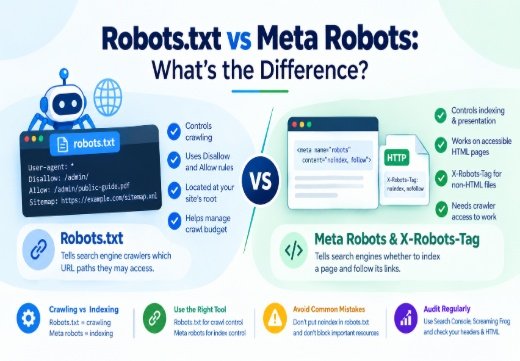
Googlebot may be blocked by server errors, authentication, broken redirects, robots.txt, or inaccessible JavaScript resources.
Use stable URLs, correct HTTP status codes, crawlable resources, and adequate server capacity. A Technical SEO Consultant can audit crawlability, rendering, logs, and architecture.
How Does Google Index Website Pages?
Crawling means Google fetched or attempted to fetch a URL. Indexing means Google analyzed it and decided whether its information should be stored. Not every crawled page enters the index.
Content analysis and canonical selection
Google processes text, titles, images, video, alt attributes, language, and metadata. It groups similar pages and selects a canonical URL; duplicates may be excluded.
A noindex directive, low-quality content, inaccessible design, or technical problem can prevent indexing. An indexed page is only eligible to appear.
Mobile-first indexing and rich results
Google uses the mobile version crawled with a smartphone agent for indexing and ranking. It should contain equivalent content, headings, metadata, images, and structured data. Do not block resources or load primary content only after interaction.
Structured data can make pages eligible for rich results such as product, recipe, article, or breadcrumb enhancements. Eligibility is not guaranteed display; markup must match visible content.
How Does Google Rank Pages in Search Results?
Google’s automated ranking systems evaluate relevance, usefulness, reliability, and query fit at page level, with site-wide signals also contributing.
PageRank, RankBrain, BERT, and MUM
Understanding How Google Search Works also involves knowing how Google’s major ranking systems process and interpret information. PageRank is a link-analysis system that remains part of Google’s core ranking systems, although it has evolved over time. RankBrain helps Google connect words with concepts, while BERT helps interpret combinations of words and their meaning, including search intent. MUM supports specific applications, but Google states that it is not currently used for general ranking.
Do not repeat entity names to target these systems; create clear content that answers the query and demonstrates expertise.
Core updates and E-E-A-T
Google improves its systems through testing and broad core updates. A ranking change is not automatically a penalty; review relevance, originality, accuracy, user experience, and evidence.
E-E-A-T—experience, expertise, authoritativeness, and trustworthiness—is a quality framework, not one ranking factor. Clear authorship, sources, experience, and accurate claims support trust.
How Can Search Console Help You Understand How Google Search Works?
Google Search Console diagnoses discovery, crawling, indexing, queries, clicks, impressions, and visibility. Its URL Inspection Tool shows discovery, crawl status, indexing, canonical, structured data, and rendering.
The live test checks whether the current page might be indexable, but does not guarantee inclusion or ranking. A request for indexing also does not guarantee entry; submit a sitemap for many URLs.
Search Console reports Google Search performance; Analytics reports on-site behavior. Neither guarantees rankings.
How Can You Improve Google Search Visibility?
To improve visibility, it is important to understand How Google Search Works and ensure that your website can be properly discovered, crawled, and indexed. Use relevant internal links and maintain a clean site structure. Submit an XML sitemap, check your robots.txt file, remove accidental noindex directives, resolve server errors, and ensure Google can render essential JavaScript and mobile content.
Create original pages that match query intent. Use descriptive titles and headings, accurate metadata, appropriate structured data, and trustworthy sources. A planned SEO content strategy and clear SEO content brief align topics, audience needs, links, and editorial goals.
Monitor Search Console and Analytics. Compare queries, impressions, clicks, rankings, engagement, and conversions. Diagnose discoverability, crawlability, indexability, or ranking first.

Areesh Ishtiaq
Freelance SEO Professional helping businesses improve visibility across Google Search, Google Maps and AI-powered search.
Explore Areesh IshtiaqFrequently Asked Questions
There is no fixed timeline. It depends on crawl scheduling, accessibility, content quality, internal links, and other factors.
No. A sitemap helps Google discover preferred URLs, but Google decides whether to crawl, index, and serve each page.
Crawling is fetching and processing a URL. Indexing is analyzing the page and deciding whether its information should be stored.
No. Google Ads are paid placements and do not directly increase organic ranking.
It may not match the query strongly enough, may face stronger competition, or may have weak quality, relevance, or authority. Indexing only makes it eligible to appear.